
Study shows BC secondary wood manufacturing has room to improve, but also needs better support
The data behind the study
A new study of British Columbia’s secondary wood manufacturing sector by Lili Sun, Rico Chan, and Bryan Bogdanski examines how efficiently firms convert inputs into outputs, and how the sector’s productivity has changed over time. For cabinet manufacturers, furniture producers, furnishings companies, and architectural millworkers, the findings are useful, but they need careful reading.
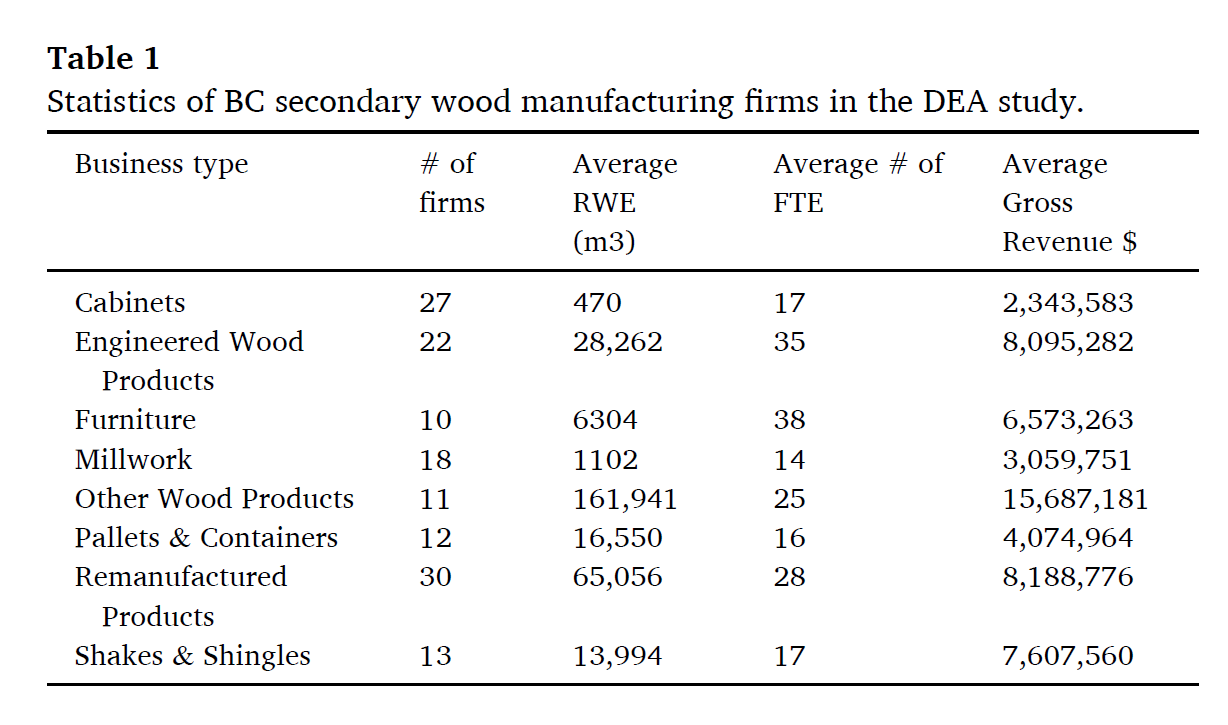
The study draws from two sources. The first is the 2016/2017 Canadian Forest Service survey of B.C. secondary wood manufacturing firms. Out of an estimated 680 firms in the province, the researchers used 143 with available information on sales, employment, and wood use. This firm-level data was used for Data Envelopment Analysis, or DEA.
The second source is Statistics Canada’s Annual Survey of Manufactures, used to examine productivity from 1990 to 2024. That data covered wages, energy and utilities, materials and supplies, and total revenues. It was used for the Malmquist Productivity Index, or MPI, which compares productivity changes over time across secondary wood manufacturing, sawmills, panel products, pulp and paper, and converted paper manufacturing.
The Canadian Forest Service survey gives more detailed firm-level insight, but it is older. The Statistics Canada data is more current, but less detailed. Furniture and cabinet business types were not included in the MPI analysis because too many observations were missing or suppressed.
How efficiency was measured
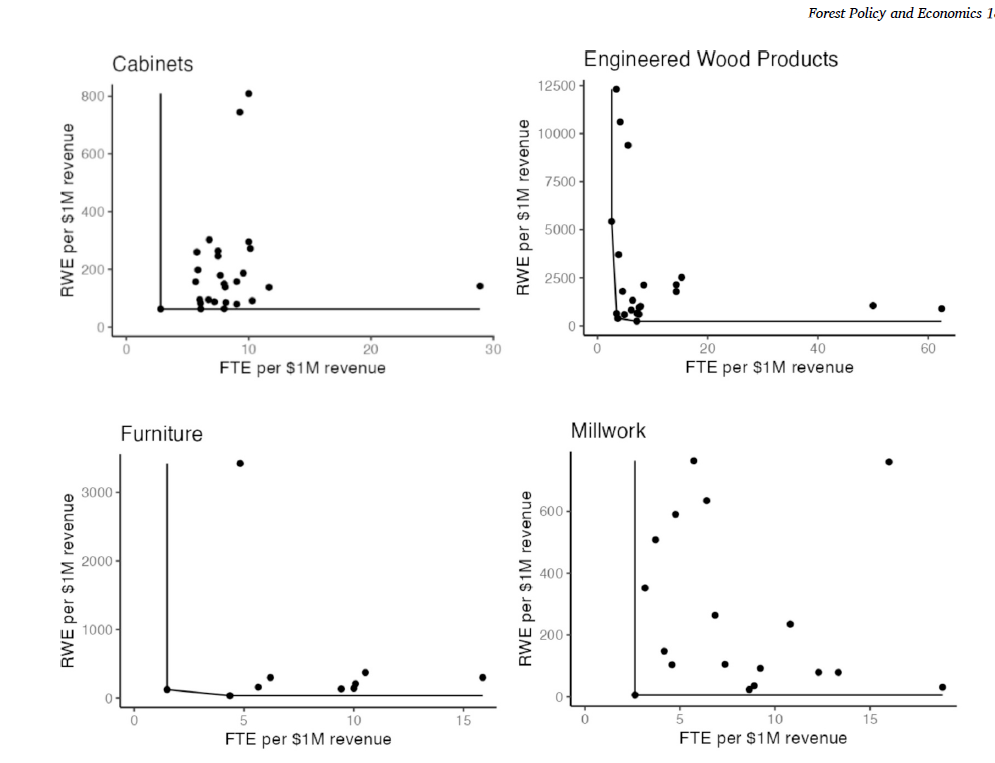
DEA compares firms against the best performers in a similar group. It creates a “best-practice frontier.” Firms on that frontier are considered efficient because, within the available data, they produce more output from similar inputs, or the same output with fewer inputs.
In the firm-level analysis, labour and wood use were the inputs, and sales was the output. Machinery, equipment, software, automation, and other capital assets were not included because the data was not available. The results mostly show how effectively firms convert labour and wood into sales, not their full production capability. Wood purchases accounted for 42 per cent of costs, with labour close behind at 37 per cent, so the inputs still capture two major operating pressures.
The study uses three efficiency measures. Technical efficiency looks at how well a firm uses its inputs. In a cabinet shop, that may show up in cut-list accuracy, nesting yield, parts labelling, edgebanding flow, assembly labour, finishing control, and installation preparation.
Scale efficiency asks whether the firm is operating at the right size for its production model. A furniture manufacturer may have skilled workers and good material use, but still struggle if runs are too short, product lines are too broad, or volume is not large enough to carry overhead.
Aggregate efficiency combines technical performance and scale. A low aggregate score does not automatically mean a company is poorly run. It may mean the firm is too small for its cost structure, too customized for its systems, short of technical capability, or operating in a market where labour and material variation are difficult to standardize.
Peer comparisons, not sawmill comparisons
 The firm-level results are not a simple comparison between value-added shops and sawmills. DEA requires comparable firms, so the researchers constructed efficiency frontiers by business type. Cabinet firms were compared with cabinet firms. Furniture firms were compared with furniture firms. Millwork firms were compared with millwork firms.
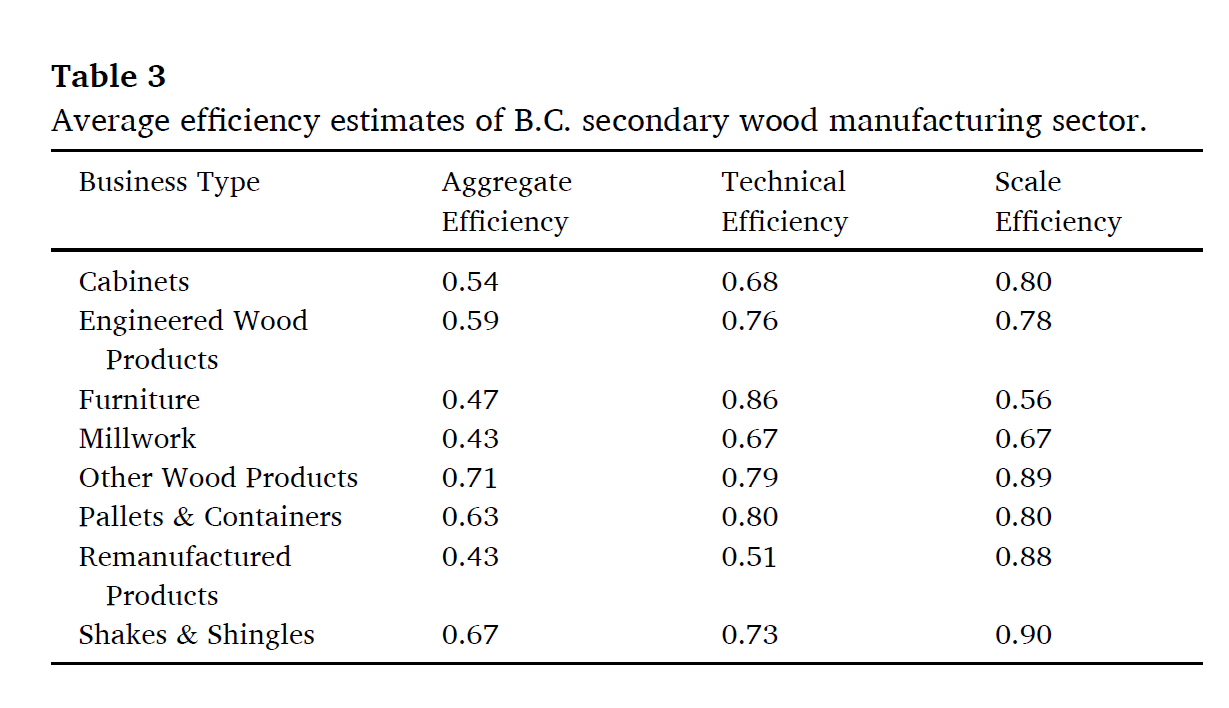
Even within those peer groups, the results show room for improvement. Aggregate efficiency across business types ranged from 0.43 to 0.71. Technical efficiency ranged from 0.51 to 0.86, while scale efficiency ranged from 0.56 to 0.90. Only 17 per cent of firms in the survey were fully efficient.
For cabinet manufacturers, the numbers point toward labour-and-material conversion. Cabinets had average aggregate efficiency of 0.54, technical efficiency of 0.68, and scale efficiency of 0.80. Many cabinet firms may be closer to workable scale than to best-practice technical performance. The opportunity is likely in the handoffs: design approval, engineering release, CNC files, hardware staging, finishing schedules, rework control, and installation feedback.
Millwork firms had average aggregate efficiency of 0.43, technical efficiency of 0.67, and scale efficiency of 0.67. Architectural millworkers face a double problem: stronger technical control, and better alignment between project mix, capacity, and scale. The efficiency loss often begins before material reaches the saw.
Furniture firms had the highest average technical efficiency, at 0.86, but scale efficiency was much lower, at 0.56. Furniture producers may be relatively capable once work is in the plant, but still constrained by volume, market access, batch size, product-line complexity, or overhead absorption.
Long-term productivity and policy implications
The MPI analysis is where the broader comparison with upstream wood manufacturing enters the study. Using Statistics Canada data from 1990 to 2024, the researchers compared secondary wood manufacturing with sawmills, panel products, pulp and paper, and converted paper manufacturing.
Sawmills and panel sectors showed stronger and more sustained productivity growth, while secondary wood manufacturing showed weaker and more uneven performance. SWM firms improved in their use of existing technologies, but those gains were offset by weak and variable technical change. Put plainly, firms appear able to adjust and improve, but the sector has not consistently moved the productivity frontier.
That gap should be treated as a policy issue. If Canada wants more value from each cubic metre of harvested timber, secondary wood manufacturing cannot be treated as an afterthought to forestry. Cabinetry, architectural millwork, furniture, furnishings, and other secondary wood manufacturers turn primary wood products into jobs, buildings, interiors, exports, and finished goods.
The study also makes the data problem visible. Cabinet and furniture business types were not represented in the long-term productivity analysis because too much data was missing or suppressed. Capital input data was unavailable, so the analysis could not fully account for machinery, automation, software, or equipment differences. Canada lacks the detailed, current, firm-level and subsector-level data needed to understand where support should go.
Cabinet shops need tighter technical control over workflow, material yield, rework, finishing, and installation coordination. Millwork firms need both production discipline and a clearer fit between project type, capacity, and scale. Furniture and furnishings manufacturers need stronger scale economics, repeatable volume, and product-line discipline.
But firms cannot carry the full burden alone. The study points toward coordinated investment in machinery, digital optimization tools, training, production planning, yield management, workflow efficiency, automation, digitization, robotics, and artificial intelligence. It also warns that equipment alone is unlikely to lift productivity without the organizational capacity to use it well.
The opportunity is not simply to make individual shops more efficient. It is to build a stronger secondary wood manufacturing system: better data, technical assistance, workforce development, capital support, and research tied to the realities of custom and semi-custom production. Secondary wood manufacturing needs the same seriousness if Canada expects it to carry more of the value-added future.
Source:
Sun, L., Chan, R., & Bogdanski, B. (2026). Efficiency and productivity analysis of the secondary wood manufacturing sectors in British Columbia. Forest Policy and Economics, 188, 103812. https://doi.org/10.1016/j.forpol.2026.103812
 Tyler Holt is the Editor of Wood Industry / Le monde du bois magazine. He has a master’s degree in literature and publication, and years of experience in the publishing and digital media industry. His main area of study is the effect of digital technologies on industrial and networked production.