
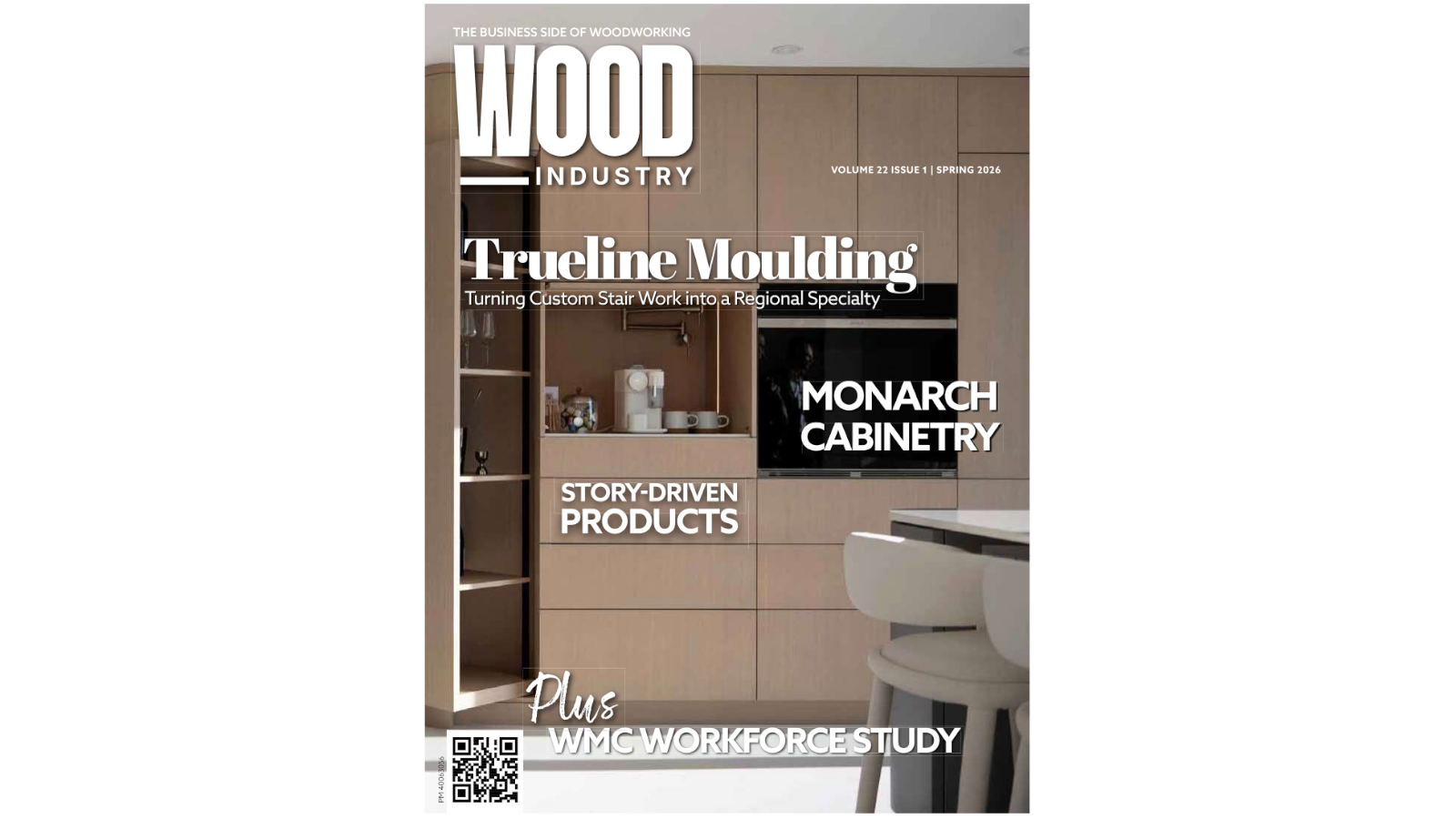
Wood Industry Spring 2026 is out!
Hello Industry Partners,
See the full pdf version of the spring issue here.
In a market defined by pressure to expand, adapt, and differentiate, the most effective manufacturers are not those doing more. They are the ones doing the right things with greater clarity, control, and intention. Across this issue, that idea takes shape through specialization, structure, shared standards, workforce strategy, and communication.
At Trueline Moulding Group and Monarch Cabinetry, two very different operations point to the same underlying discipline. Trueline has built its business by narrowing its focus to stairs, railings, and mouldings, expanding capability within that lane while tightening its control over engineering, materials, and installation. Monarch, by contrast, operates as a small, contractor-driven shop, where continuity of relationships and in-house installation reduce variability and keep quality tied directly to execution on site. In both cases, growth is not defined by scale alone, but by how tightly the work is controlled from conversation through completion.
That same emphasis on structure extends into the role of industry organizations. Sandra Wood of the Canadian Kitchen Cabinet Association highlights how plant tours create practical, peer-driven learning environments where manufacturers exchange real operational insight, not theory. At the Architectural Woodwork Manufacturers
Association of Canada, Kasia Robinson outlines how standards function as operational infrastructure, shaping estimating, quality control, and project alignment long before issues arise. Together, these perspectives reinforce a shared principle: consistency across the industry is built through participation, shared language, and deliberate systems.
Workforce development is examined through a different lens in the Wood Manufacturing Council’s pilot study. Rather than treating labour challenges as abstract shortages, the research breaks them down into shopfloor decisions—how roles are defined, how onboarding is structured, how workspaces are designed, and how advancement is communicated. The findings are direct. Recruitment, retention, and performance are shaped less by broad initiatives and more by clear, practical systems that make entry, learning, and progression visible.
On the commercial side of the business, two perspectives address how manufacturers connect with the market itself. Freya Hannah of Cieblink draws from her experience across distribution and software to argue that credibility in sales is built on clarity, follow-through, and an understanding of how shops actually operate. Her perspective reframes sales not as persuasion, but as alignment with the realities of production and procurement.
Linda Farha of Zenergy Communications extends that idea outward, showing how storytelling has become a critical tool in translating technical capability into relevance for designers and specifiers. In a crowded market, products alone no longer differentiate. Context, application, and narrative are what make them usable and memorable.
Across these stories, a consistent pattern emerges. Performance in this industry is not driven by any single factor, whether it is technology, labour, or market demand. It is the result of how well systems are defined and how clearly decisions are communicated — internally and externally.
As you move through your own operations this season, consider where clarity can replace assumption.
Whether in production flow, workforce structure, or customer communication, the shops that move forward are the ones that reduce ambiguity before it becomes cost.
Thank you for reading, and for continuing to build that clarity into your work