
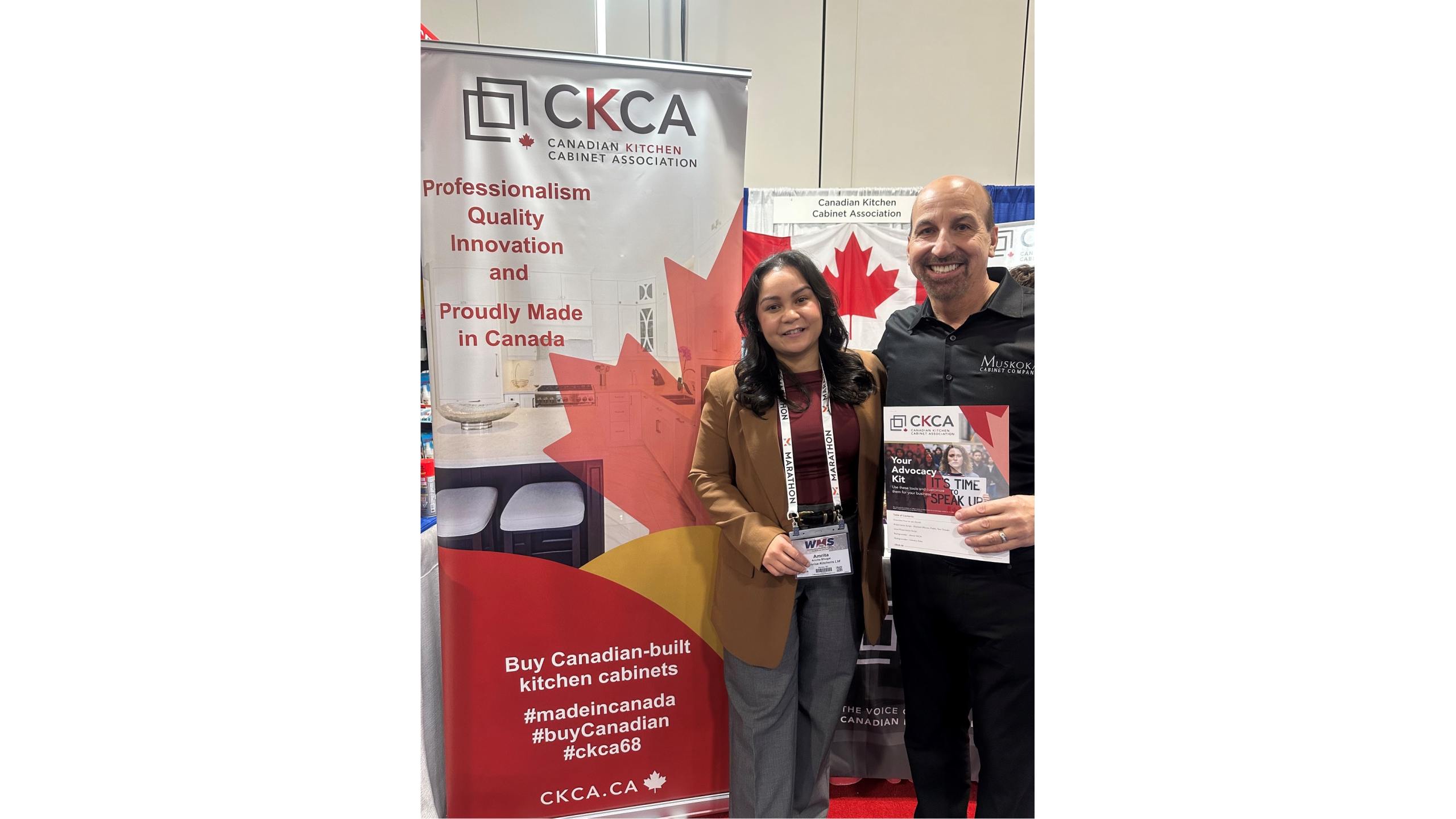
It’s Time to Speak Up!
CKCA recently hosted our Spring Regional event in Hamilton, Ontario. The province has been feeling the effects of housing slowdowns, tariffs, and the ongoing market pressures caused by increasing imports. CKCA President Amrita Bhogal (Sunrise Kitchens, Surrey, BC) and Vice President Luke Elias (Muskoka Cabinet Company, Alfred, ON) provided an update on CKCA’s advocacy work and spoke to an industry audience of more than 120 kitchen cabinet manufacturers and suppliers.
What Amrita and Luke understand well is the urgency of the situation because their own businesses are living through these market conditions firsthand. While they are actively speaking up for our industry, they are also encouraging others to do the same.
Please consider this your call to action. Contact your MP and invite them into your shop. Show them what you do, how many people you employ, and why we need help from the federal government now. If you need help reaching out to your local MP, contact CKCA at info@ckca.ca and we’ll send you advocacy tools to help guide the conversation.
Before doing that, here is what Amrita and Luke recently shared with members.
Amrita: One of the most important priorities for the CKCA right now is advocacy. Our industry is facing real pressure, and the CKCA Board has been very active on two major fronts.
• First, raising awareness in Ottawa about the challenges facing Canada’s kitchen cabinet industry and the need for stronger support for domestic manufacturing.
• Second, supporting the safeguard initiative that addresses unfair trade pressures and import issues impacting our members.
Over the past several months, CKCA has been working closely with a government relations firm in Ottawa. This work is only possible because of the additional advocacy contribution members paid during renewal earlier this year. That investment is already making a difference.
Together, we’ve participated in more than a dozen meetings with elected officials and government departments, with many more still to come. We’ve also had several CKCA members directly involved in those conversations, and we sincerely thank everyone who has contributed their time and expertise.
Luke: Our message to government has been very clear.
Canada’s wood products manufacturers, including cabinet manufacturers, are under serious pressure from extraordinary levels of low-priced imports, particularly from Asia.
What we are seeing is not just a cyclical slowdown. It is a structural shift in global trade. Today, Canada’s kitchen cabinet industry has the capacity to produce approximately 1.62 million cabinet units annually. But current production is only about 756,000 units. That means more than 53% of our manufacturing capacity is sitting idle.
At the same time, imports have risen roughly 36% over the past two years and now account for nearly half of the Canadian market. Domestic manufacturers now account for only about 44% of the market.
The reality is simple: Canada already has the capacity to replace imported cabinets using existing domestic production capacity.
Amrita: We’ve also been emphasizing that there are important gaps in current federal programs. The federal Buy Canadian strategy is a positive step, but it needs to go further.
We are asking government to specifically include value-added Canadian-made products like cabinetry within federal housing and procurement programs.
At our National Forum last fall, the CKCA Board made a clear statement that homes built under federally supported housing programs should include Canadian-made products, including Canadian-made kitchen cabinets.
Luke: If taxpayer dollars are being used to build homes in Canada, then Canadian manufacturing jobs should benefit from those projects as well. This is not about supply shortages or inflation risk. In fact, the industry currently has approximately 860,000 units of idle production capacity, which exceeds the total volume of imported cabinets entering Canada today.
Including cabinetry in federal housing programs would immediately support Canadian jobs, Canadian factories, and Canadian investment.
Amrita: The second major area of advocacy is the safeguard initiative.
CKCA is supporting the work being led by an expert trade law firm and a government relations firm through the Canadian Wood Products Alliance. Many CKCA members are also directly involved in that alliance effort.
Luke: As many of you know, the industry has been heavily impacted by U.S. Section 232 tariffs on timber, lumber, and derivative wood products. Last fall, exports of cabinets to the United States were hit with a 25% tariff. That has now increased to 50%.
This came as a major shock to the industry because we believed we were protected under CUSMA.
Today, we estimate that roughly 20% to 30% of our industry depends on U.S. export business. The impact won’t stop with exporters. As companies lose U.S. business, more production from around the world is being redirected into Canada.
Global overcapacity, particularly from Asia, combined with weakening foreign demand, is pushing more low-priced product into the Canadian market because Canada remains a relatively low-barrier market.
Amrita: That’s why CKCA welcomed the Government of Canada’s decision to launch a global safeguard investigation into imported kitchen cabinets. It’s an important step toward restoring a fair and level playing field.
But we’ve also made it clear that timing matters. A safeguard investigation can take more than a year, and many manufacturers simply do not have that kind of time.
Luke: Without immediate action, we believe there will be further closures, layoffs, and permanent loss of manufacturing capacity. Industry forecasts are already pointing toward an additional 20% revenue decline in early 2026, representing roughly half a million fewer cabinets produced annually.
That is why CKCA is calling on government not only to move the safeguard investigation forward urgently, but also to implement interim tariffs now while the investigation proceeds. A safeguard measure would help stabilize pricing, restore domestic production, put existing idle capacity back to work, and prevent further plant closures.
Amrita: CKCA will continue advocating strongly on behalf of this industry. We’ll continue meeting with government, working with our partners, and keeping pressure on the issues that matter most to our members.
Luke: CKCA will continue keeping members informed along the way through CKCA’s weekly news, and you can always find our media releases and advocacy updates on the CKCA website.
This is ultimately a timing issue. If manufacturing capacity is lost, it will not easily return.
Now more than ever, we need this industry’s continued support. Take a look at the Canadian Wood Products Alliance website, sign up, and then speak up by sending letters to your Members of Parliament.
Every effort to raise awareness helps strengthen the industry’s position. To those already taking action, we are very grateful for your continued support. This is going to take a strong industry effort — don’t wait, act now and speak up!
Sandra Wood is the Secretary and Executive Director for the CKCA. She enjoys “connecting the dots” and facilitating strong networking opportunities to engage members. She believes associations are about fostering strong business relationships fueled by an empathic and sound business approach.