
Canada’s secondary wood manufacturers face slower orders and tighter inventories
Canadian secondary wood manufacturers entered 2026 with less work moving through the system than a year earlier. Shipments were down, new orders were weaker and backlogs had declined in both major industry groups covered by Statistics Canada’s Monthly Survey of Manufacturing.
The survey does not capture every company in the sector. It tracks reported manufacturing sales, orders, inventories and related measures. Still, it gives a useful reading of direction across the industry.
This report covers two large groups. The first is other wood product manufacturing, which includes millwork, architectural woodwork, windows and doors, pallets, trusses, prefabricated building components and related products. The second is household and institutional furniture and kitchen cabinet manufacturing, which includes cabinet shops, residential and institutional furniture producers, store fixture manufacturers and similar businesses.
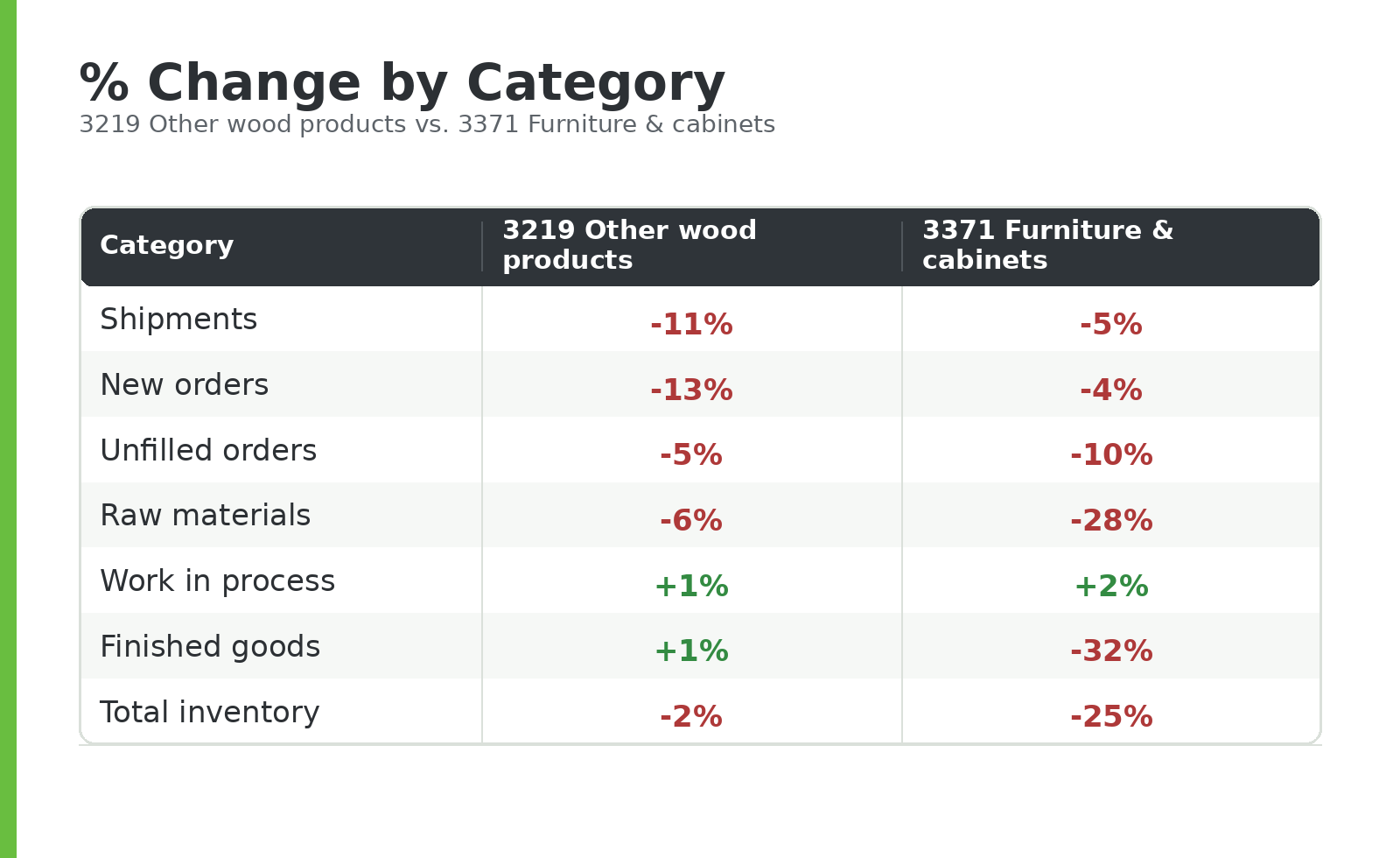 Both groups weakened in the first quarter, but not in the same way.
In other wood product manufacturing, shipments fell from $2.77 billion in Q1 2025 to $2.46 billion in Q1 2026. That was an 11 percent decline. New orders fell more sharply, dropping 13 percent from $2.86 billion to $2.49 billion. Unfilled orders also declined, falling 5 percent to $1.24 billion.
That combination matters. A drop in shipments can sometimes reflect timing. Finished work may leave the plant later than expected, or construction schedules may shift. But when new orders fall faster than shipments and backlogs also shrink, the forward workload is weaker.
Prices did not explain much of the decline in this group. The Industrial Product Price Index for other wood products rose only slightly, by about 0.6 percent. With prices nearly flat, the lower shipment value likely reflects less volume, a different product mix or both.
Inventories moved more slowly. Total inventory fell 2 percent, from $4.57 billion to $4.46 billion. Raw materials, fuel and supplies were down 6 percent, which suggests more cautious purchasing. Finished goods rose 1 percent, and work in process also rose 1 percent. Producers appear to have reduced exposure to raw materials, but completed stock did not fall at the same pace as shipments.
The furniture and cabinet group showed a different pattern. Shipments declined from $2.04 billion to $1.92 billion, a 5 percent drop. New orders fell 4 percent, from $2.00 billion to $1.92 billion.
On the surface, that looks like a milder decline than in other wood products. But prices changed the picture. The price index for furniture and cabinets rose about 6 percent. Higher prices helped support reported sales values. After allowing for that increase, the real volume of shipments likely weakened more than the current-dollar numbers suggest.
Backlogs also declined. Unfilled orders fell 10 percent, from $1.90 billion to $1.71 billion. For cabinet and furniture manufacturers, a smaller backlog leaves less room to absorb slower quoting activity, project revisions or installation delays.
Inventory was the clearest adjustment in this group. Total inventory fell 25 percent, from $3.22 billion to $2.42 billion. Raw materials fell 28 percent, and finished goods dropped 32 percent. Work in process rose 2 percent.
That looks more like an inventory correction than a full stop in production. Companies were carrying less material and fewer finished goods while still keeping some jobs moving through the shop. For cabinet and furniture producers, that may reflect tighter buying, less speculative inventory and more job-specific ordering.
Employment declined in both groups, but less sharply than shipments or orders. Employment in other wood products fell about 3 percent, from 36,661 to 35,569. In furniture and cabinets, employment fell about 3.2 percent, from 39,310 to 38,065.
That suggests companies were not cutting capacity as aggressively as demand indicators weakened. Some may have reduced overtime, shortened schedules or accepted lower utilization while trying to keep experienced workers. The data does not show hours worked, layoffs or plant utilization, so it cannot explain exactly how companies managed labour. But it does not point to a severe staffing contraction.
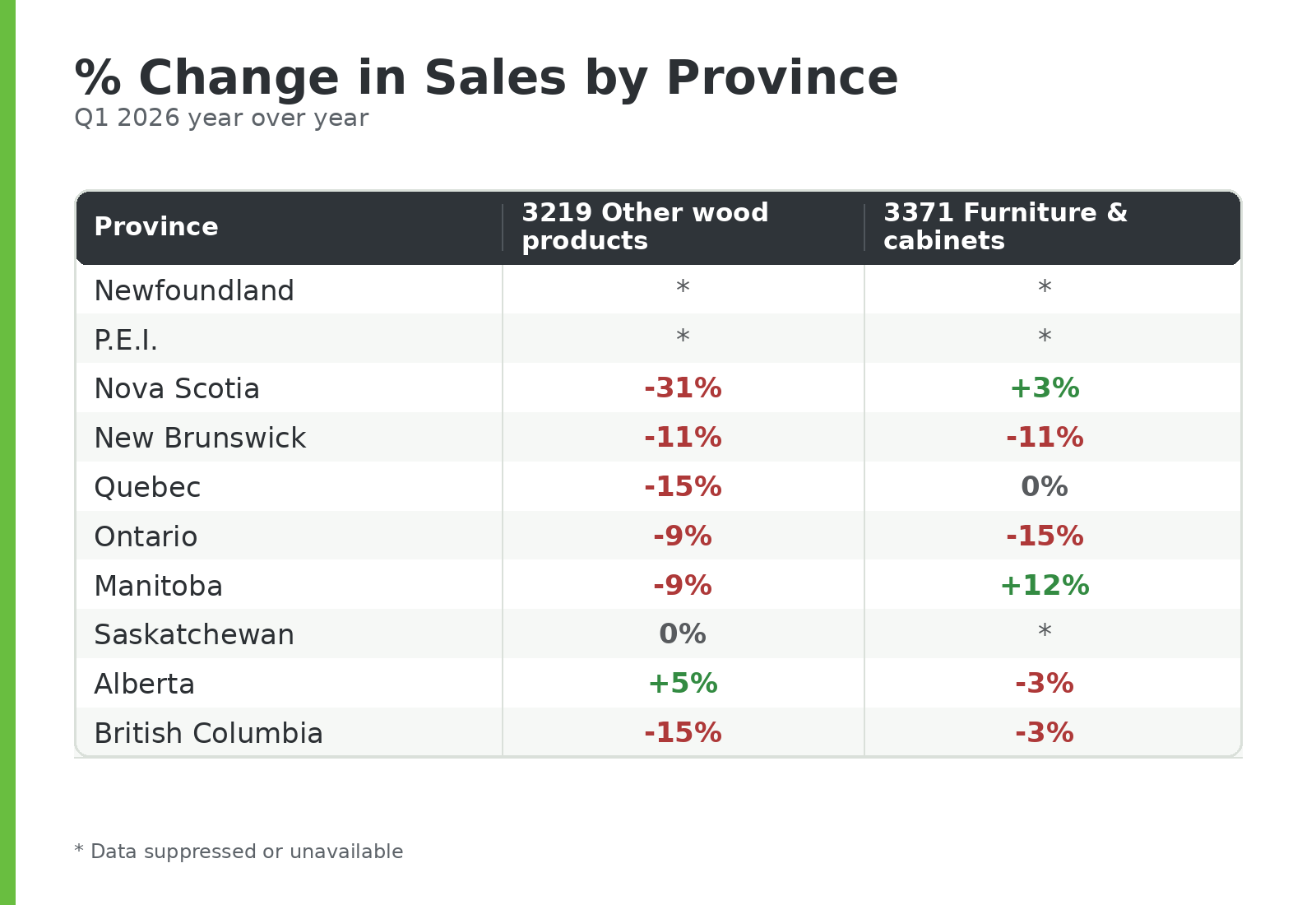 Provincial sales results were uneven.
In other wood products, the largest producing provinces carried much of the decline. Quebec sales fell 15 percent, from $1.04 billion to $887.6 million. British Columbia also fell 15 percent, from $588.9 million to $497.7 million. Ontario declined 9 percent, from $655.4 million to $594.9 million.
Alberta was the main exception, with sales rising 5 percent to $271.7 million. Saskatchewan was essentially flat. Manitoba fell 9 percent, New Brunswick declined 11 percent and Nova Scotia dropped 31 percent from a smaller base.
In furniture and cabinets, Ontario had the largest decline among major provinces. Sales fell 15 percent, from $770.7 million to $657.5 million. Quebec was nearly flat, moving from $706.6 million to $703.2 million, though national price increases mean physical volume may still have declined. British Columbia and Alberta each fell 3 percent. Manitoba rose 12 percent, from $115.4 million to $128.6 million.
Overall, the first quarter showed a slower market and tighter inventory control. Other wood product manufacturers faced weaker shipments, orders and backlogs with little help from price increases. Furniture and cabinet manufacturers had more price support, but backlogs fell and inventories were cut sharply. The sector was not collapsing, but it was operating with less forward work and more caution than a year earlier.